
Yoga Asana Fundamentals: The Stuff Happening in Every Pose You've Ever Done
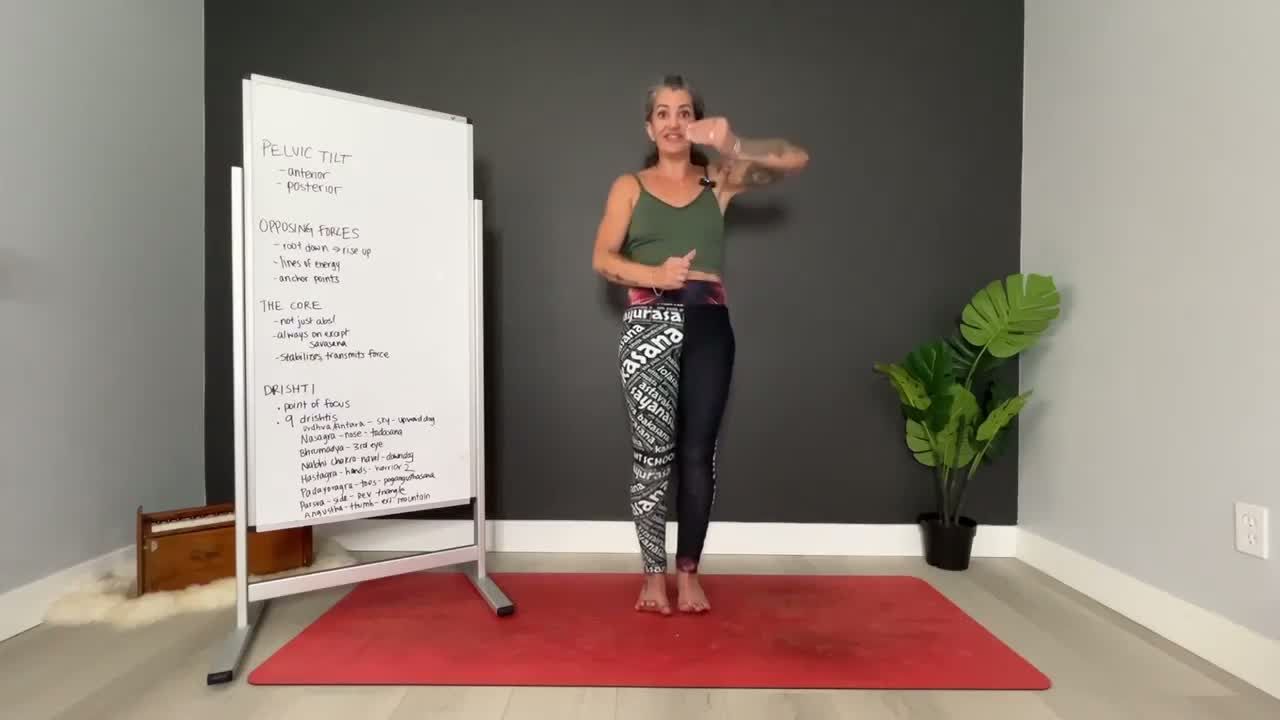
You've done thousands of poses. Maybe tens of thousands. But here's a question worth sitting with: do you actually know what's happening inside them?
Most of us learn yoga shape by shape. Down dog, warrior, pigeon, repeat.
Eventually, you hit a ceiling where you've been practicing for years but something still feels like it's missing, and you can't name what it is.
What's missing is usually the fundamentals. Not poses, but the invisible stuff that runs underneath all of them. Once you can feel these things in your own body, your whole practice shifts.
Here are five fundamentals your practice might be missing:
Pelvic Tilt and Your Personal Neutral
In most poses, we're working toward something called "Anatomical Zero," looking for Mountain Pose in every pose.
Finding your "personal neutral" is a big piece of finding Anatomical Zero in every pose, and it has to do with something called "Pelvic Tilt."
Pelvic tilt is where your pelvis sits in relation to your spine.
Anterior tilt (Ballerina): is where the pelvis tilts forward. Your hip points point down, your tailbone lifts up, and your lumbar spine curved in.
Posterior tilt (Cowboy): is where the pelvis tilts backwards. Your hip points point up, your tailbone is tucked under, your lumbar spine rounded out or flattened.
Your job is to find the middle ground between each, and search for that neutrality in most yoga poses.
I say most, because some poses actively require you to have your pelvis tilted in one direction or the other. But for poses that don't, we're looking for that middle-ground neutral.
The Power of Opposition
Every action has a counter action. To strengthen one muscle, another has to lengthen so the contraction can happen. You are built out of opposites.
This is one of those ideas that quietly rewires your practice, because it shows up two ways:
Activating the opposing and supporting actions is how a pose gets actual structure instead of just being a shape you flop into. And those same counter actions are how your body comes back into balance after you've worked it hard.
On the mat, opposition has a few flavors.
Root down to rise up. This is Newton's law in action. Every force in one direction has an equal force in the opposite direction.
As an example, stand in Warrior II and just hang out in it. Now press your feet into the floor, grow taller through your middle, and reach out through both arms. Same pose, completely different experience. You feel powerful and lifted instead of parked there waiting for it to be over.
Anchoring. Anytime you twist one way, something has to pull the other way, or you'd just keep spinning.
As an example, get into twisted chair pose. If you don't draw the opposite hip back, nothing stops the rotation, so you'd twist clean past the pose and fall over. The anchor, knee back and hip back, is what gives the twist a foundation.
Effort and ease. The Yoga Sutras (one of yoga's classical philosophical texts) say almost nothing about poses! There's basically one line: the pose should be steady and easeful. Equal parts effort and ease. It's SO simple, and yet challenging to do.
The bottom line is this: If you can't breathe smoothly, you're working too hard. If you're mentally humming and waiting for the next pose, you're not working hard enough.
Put all of that together and you get lines of energy, which is how you carry energy through your whole practice. It means anchoring down through one (or more) body parts and REACHING through the opposing body parts, almost like you're conducting electricity through your body.
When we do that, the pose comes alive. Alert, awake, electric. It also feels LIGHTER! When everything is connected and reaching, nothing is lazy, the pose is actually easier to hold.
Finding Activation: What Core Actually Is
You hear engage your core "core" and think "tighten your abs." But your core is so much more than those abs.
Your core is a whole system of muscles, almost everything from your shoulders to your thighs.
Picture a corset wrapped around you in every direction, working in nearly every movement you make. Plenty of these muscles sit deeper than the abs you can see in the mirror. They stabilize you while you move. They transfer force from one limb to another. They start movement in the first place.
Because your core works as a stabilizer and a force-transfer center way more than it works as a mover, building strength and stability there changes basically everything else you do on the mat.
So here's a question to chew on: name a yoga pose that has nothing to do with your core.
Other than Savasana....that will be a tall order!
Space Versus Compression
One of the main tenets of the physical practice is creating space in your joints - or said another way, using your musculature to lift yourself up and out of your joints.
If we don't lift up out of our joints, over a period of decades, we can experience a degradation in the cartilage between our bones, and our goal is to be able to practice until we're 95.
That means we need to learn how to LIFT UP. The way we do this is to actively push the ground away with whatever is on the floor, and actively lift up and away from the floor using whatever is not on the floor.
So think in Warrior 3 for instance - how can you be standing on one leg, and activating the muscles of your outer hip such that it feels like you're lifting yourself UP OFF of that hip?
We want your muscles doing the work so your joints don't take the hit.
This is the difference between forcing a shape and supporting one, and once you feel it you stop white-knuckling your way through poses.
Finding Your Gaze: Drishti
Yoga is a practice of focus.
We find quiet by getting the mind and body so united there's no room left for anything else. The problem is your eyes. Let them dart around the room, clocking what everyone else is doing and checking your own reflection, and your mind goes right along with them.
So the yogis gave every pose a gazing point. That's a drishti.
It's part of the physical shape, and it's also a thread back to two of the deeper limbs of yoga, Pratyahara (withdrawal of the senses) and Dharana (concentration). It's a reminder of where you're headed, how to settle the noise in your head, and the larger thing you're a part of.
A drishti is a prescription. It tells your attention exactly where to go so you stay balanced, focused, and fully here. Try giving your gaze a job in your next practice and watch how much quieter your head gets!!
There are nine of them in asana practice, and I won't go into them all right here but the video I link you to below covers them.
If you want to explore these concepts physically, check out this video below on YouTube, a small snippet from my upcoming Yoga Teacher Training that starts in July.
Want to Actually Understand Your Practice?
Here's the thing about everything you just read. You can feel all of it in your own body, today, on your own mat. That's the invitation.
But feeling it and understanding it are two different things.
The reason these fundamentals stay invisible for most practitioners is that nobody ever pulls them apart and explains what's actually happening, why your pelvis does what it does, why one pose feels effortless and another feels like a fight, why your wrists ache in some shapes and not others.
That's what we dig into inside a teacher training.
And no, you don't have to want to teach. Plenty of people come through teacher training purely to understand their own body and their own practice at a depth they didn't know was available.
If you decide you're ready to dig deeper into your practice, join us for this 16-week Teacher Training journey. You'll unpack so much about your physical practice, discover the world of yoga philosophy and gain a whole new perspective for understanding yourself, and the world.
Click here for more info about the 200 hour Yoga Teacher Training.
