
Why Your Jump Back from Crow Isn't Happening (And How to Fix It)
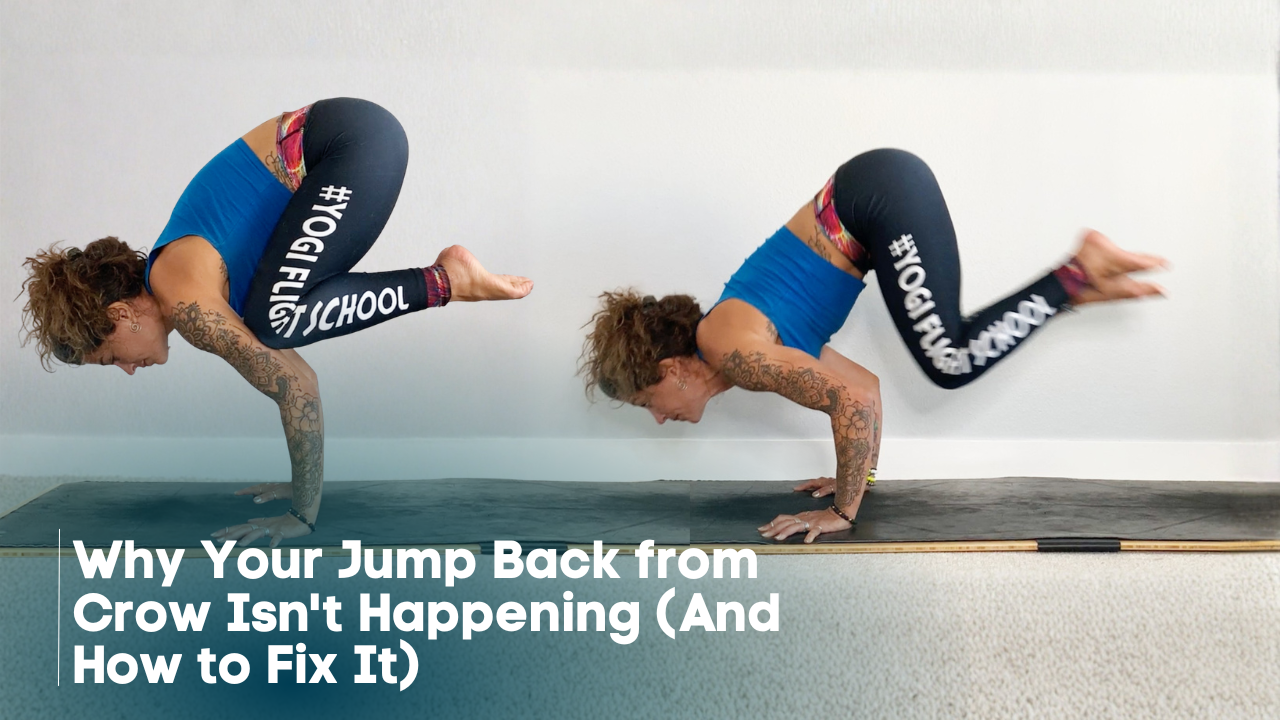
You're in Crow and everything is going well.
Then the teacher says, "...aaaaand jump back to Chaturanga."
Oh.
You know what you're supposed to do because you've watched other people do it plenty of times. You've probably even thought, that doesn't look too bad. And then you actually try it.
Your brain starts shouting NOPE. Your knees develop a very strong attachment to your upper arms, and suddenly you're hovering there, wondering how on earth you're supposed to get out of this situation.
Eventually, you decide to go for it. Your legs move approximately three inches backward before both knees SLAM into the mat.
WTAF. You look up, silently cursing the teacher for suggesting this in the first place, and consider whether you could just stay in Crow until the end of class.
Sound familiar?
I see this often. Someone can hold a strong Crow pose happily, but the second they try to get their legs moving backward, everything comes to a standstill. It's not necessarily that they don't have the strength to send their legs back. They just can't actually get themselves to make the move.
So let's look at what's going on, and how to practice it without making every attempt feel like a near-death experience.
Why do your legs suddenly refuse to move?
A lot of the time, it's fear.
You know that your face is fairly close to the floor already and that your hands are currently doing a pretty important job of holding you up. At this point, the idea of sending both legs flying backward might not feel like the most sensible decision you've ever made.
So you hesitate.
You start to move, change your mind halfway through, and before you know it your knees are heading straight for the mat.
The irony is that the cautious, half-hearted version can be harder than giving the movement enough energy to get through it.
I'm not suggesting you fling yourself backward and hope for the best. Please don't. But you do need to get comfortable with the idea of actually moving your legs behind you, rather than trying to lower them down inch by inch.
And there are a few things that can help.
Three things that will help get you moving
1. Breathe out. Properly.
Take a good inhale while you're in Crow, then give me a strong exhale as you move backward.
Really engage your belly. If making a noise helps, make a noise. I'm talking a proper, slightly ridiculous "UMMMPHHH".
When you're nervous, it's very easy to hold your breath and turn yourself into one big ball of tension. The exhale gives you something to work with and helps you initiate the movement.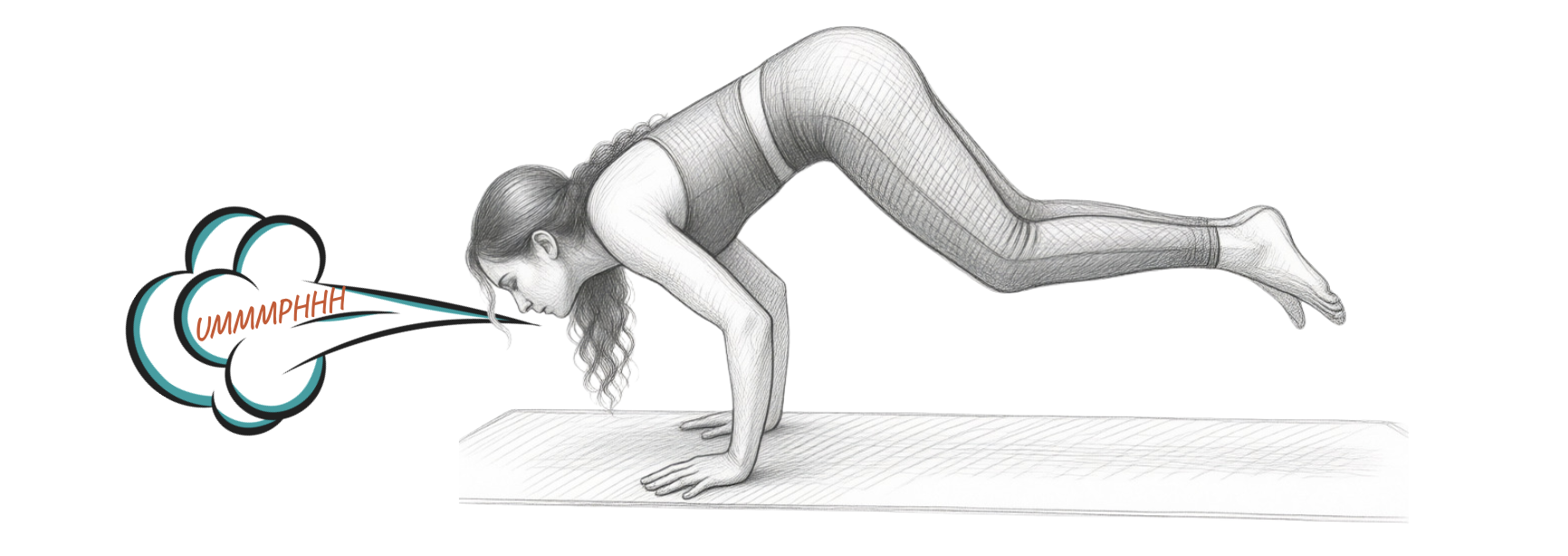
2. Bring your chest forward.
As you move back, you need to shift from the rounded, protracted chest position you're using to balance in Crow toward something more like a Baby Cobra chest.
Think about bringing your sternum forward and lifting through your chest, rather than staying rounded over your arms.
Keep your gaze forward, too.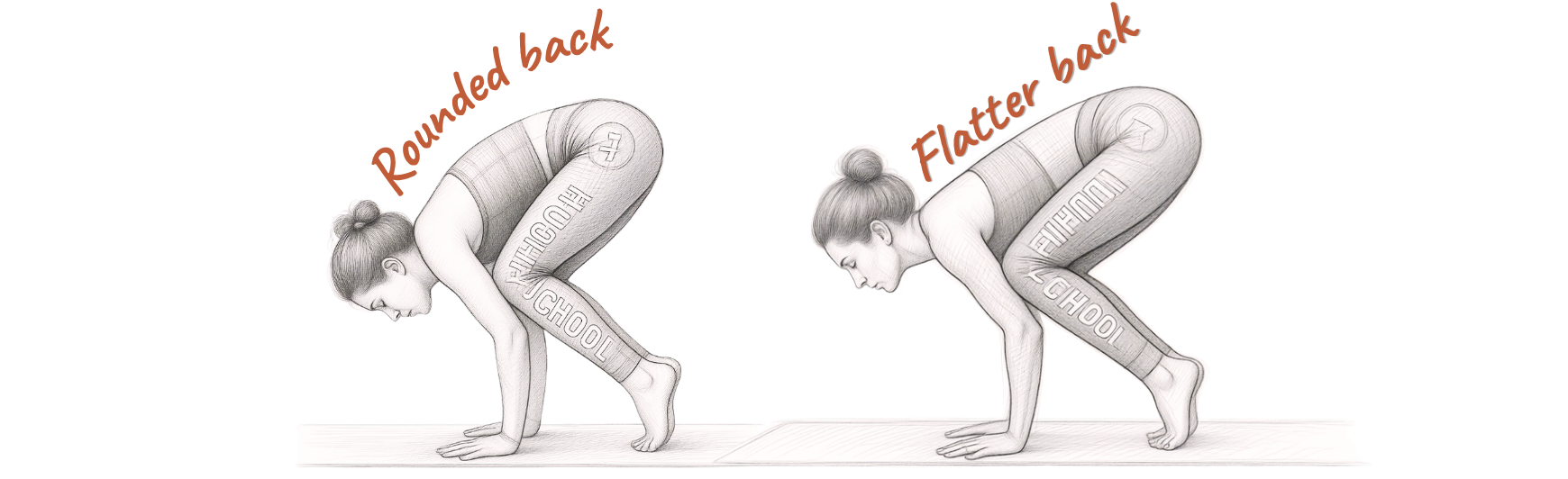
3. Stop asking your legs to move in slow motion.
This is a big one.
You start to extend your legs, everything looks promising, and then... nothing. You're kind of hanging out in an awkwardly spaced table-top pose you didn't actually want to be in.
You need to send your legs back with some speed. Not a wild kick, but a definite, committed movement.
Think of shooting your legs behind you, rather than slowly lowering them toward the floor (and don't forget to keep bringing your chest forward at the same time!).
It's the combination of those actions that gets you through the transition.
Give yourself a way to practice it
I know the goal is to land in Chaturanga. But if you're currently getting stuck halfway and dropping your knees onto the mat, let's take the pressure off getting that perfect landing just yet.
Come into Crow. Take your inhale, bring your chest forward, then exhale strongly as you send your legs back. Let your knees land on the floor a little behind your hands.
That's it.
Do it again. And again.
Once that starts to feel more familiar, try to get your knees to land a little further back and then a little further back again. You're gradually getting used to the sensation of moving your legs while your weight is supported by your hands.
Eventually, you can start working toward landing all the way back in Chaturanga.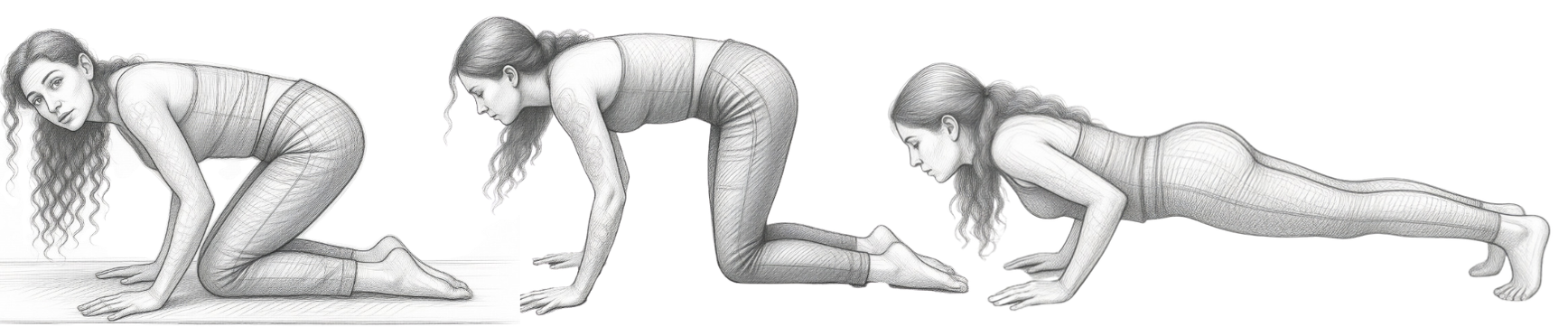
Psst: click here if you've been wondering if you need Chaturanga before working on arm balances!
And please, don't be shy about making the noise. A big, dramatic "UMMMPHHH" on the exhale can be surprisingly helpful when you're learning this.
Yes, you might feel a bit ridiculous. That's fine. You can return to being a quiet, sophisticated yogi once you've got it.
Ready to land in Chaturanga?
Of course, getting your legs back is only half the job. You also need to be able to manage the landing.
If you're thinking, "OK, but what happens when I get there and my shoulders collapse?", that's exactly the kind of thing we work on inside my Chaturanga Masterclass.
We break Chaturanga down into its component parts, so you can understand what's happening, build the strength and control you need, and work toward a landing that feels a whole lot more manageable.
Check out the Chaturanga Masterclass here!
Want to see the whole thing?
Watch my YouTube video below for a demonstration of the jump back, including the very important UMMMPHHH.
Now go give it a try. And don't forget the noise.
