
The Secret to Smarter Yoga Sequencing: The Method Every Teacher Should Know

Ever try planning a yoga class and feel like your brain just hit Ctrl+Alt+Delete…twice?
You’ve got a million poses bouncing around your head and absolutely no idea how any of them are supposed to fit together, and somehow, some way, you’re expected to turn this mess into a smooth, flowing class.
Here’s the thing: most teacher trainings teach poses like sticky notes thrown at a whiteboard in a windstorm. Warrior II goes…somewhere over there. Triangle? Maybe after that. Half Moon? Only if you remember it exists that day. Or sometimes they hand you one cookie-cutter sequence and basically say, “Repeat this until the universe ends.”
Then you graduate, you start teaching, and suddenly you’re staring at your class plan thinking, "What do I even put next?". So you start shoving poses together and praying they somehow flow. Spoiler alert: they usually don’t. And even when it sort of works, it can feel random, disjointed, and like your students’ bodies are silently questioning, “Wait…am I ready for this? We haven't done a single twist yet!?”
This is the real reason sequencing yoga classes feels like a mystery wrapped in an enigma.
If you treat every pose as its own isolated "thing", your sequence will feel like an isolated collection of "things". Choppy, random, disconnected. But the moment you start looking at poses through the lens of anatomical actions, sequencing stops being guesswork. Suddenly the "things" actually click and your class becomes one long, intelligent flow instead of a random list of poses.
In this week’s blog article, I’m breaking down the anatomical sequencing method that makes planning your classes easier, smarter, and so much more effective. Once you read this, you’ll wonder how you ever sequenced without it.
Similar shapes are the secret weapon of sequencing.
Let’s start with something about sequencing that most teacher trainings never teach: many yoga poses are actually the same shape…just flipped, rotated, or reorganized.
Seriously, once you see it, you cannot unsee it.
Triangle → tip it sideways → hello, Half Moon
Half Moon → shift the weight into your arms → boom, Eka Pada Koundinyasana B.
(psst, if your half moon is wobbly AF, check out this article!)
Same external rotation in the front leg.
Same neutral line in the back leg.
Same femur actions, same hip story…
Just expressed in different orientations.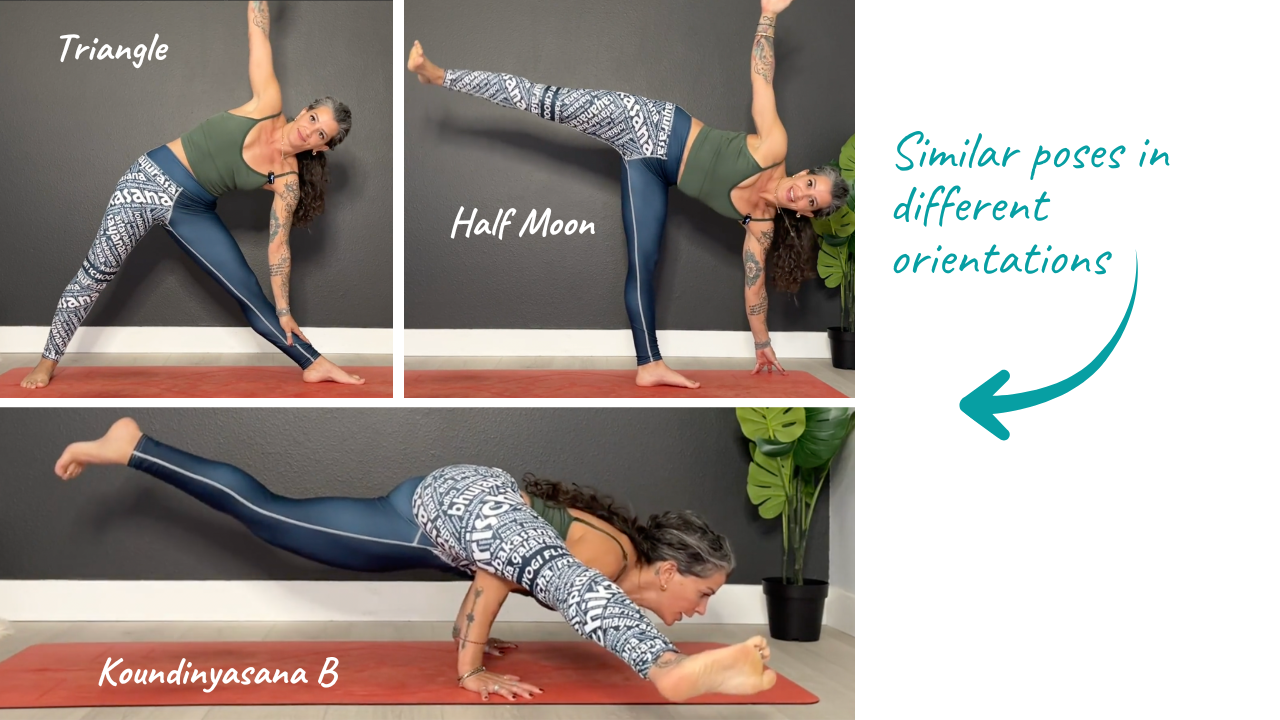
Here’s why this actually matters for sequencing: when you teach the same anatomical pattern in multiple orientations, you give your students’ bodies a chance to learn that pattern gradually, layer by layer. You’re repeating the same concept, but increasing the demand in a way the nervous system and joints can actually handle.
This is what turns a sequence from “just some poses” into something that feels intelligent, progressive, and physically logical. Students feel prepared. The peak pose feels inevitable rather than confusing. And your class has a through-line instead of a personality crisis.
And for you, the teacher? Everything gets easier. Instead of staring at a blank page wondering what to put before your peak pose, you simply ask: “What other orientations express this same shape?” Then you plug them in from simplest → strongest.
Suddenly, sequencing isn’t guesswork. You’re not throwing random poses into a flow and hoping they feel right. You’re building a clear progression where each pose reinforces the next.
There is a step-by-step approach to building a sequence.
Now that you understand why pose families matter, let’s make it practical. How do you actually identify and organize these shapes for your classes?
- Pick your peak pose first. Start with the apex of your sequence. This is the pose you want your students to be fully prepared for.
- Analyze the anatomical actions. Look at the front and back legs, hip rotation, spine orientation, shoulder position...basically all the major movements that make this pose what it is.
- Find similar poses. Which poses share one or more of these actions? Can it be practiced lying down, seated, kneeling, or standing? These become your prep poses, layered from simplest → most complex.
- Sequence by the level of demand on the body. Arrange your poses to gradually increase strength, balance, and intensity. Your students will move through a logical progression.
- Check the flow from every angle. Make sure transitions feel natural and that each pose prepares the body for the next, reinforcing the anatomical pattern.
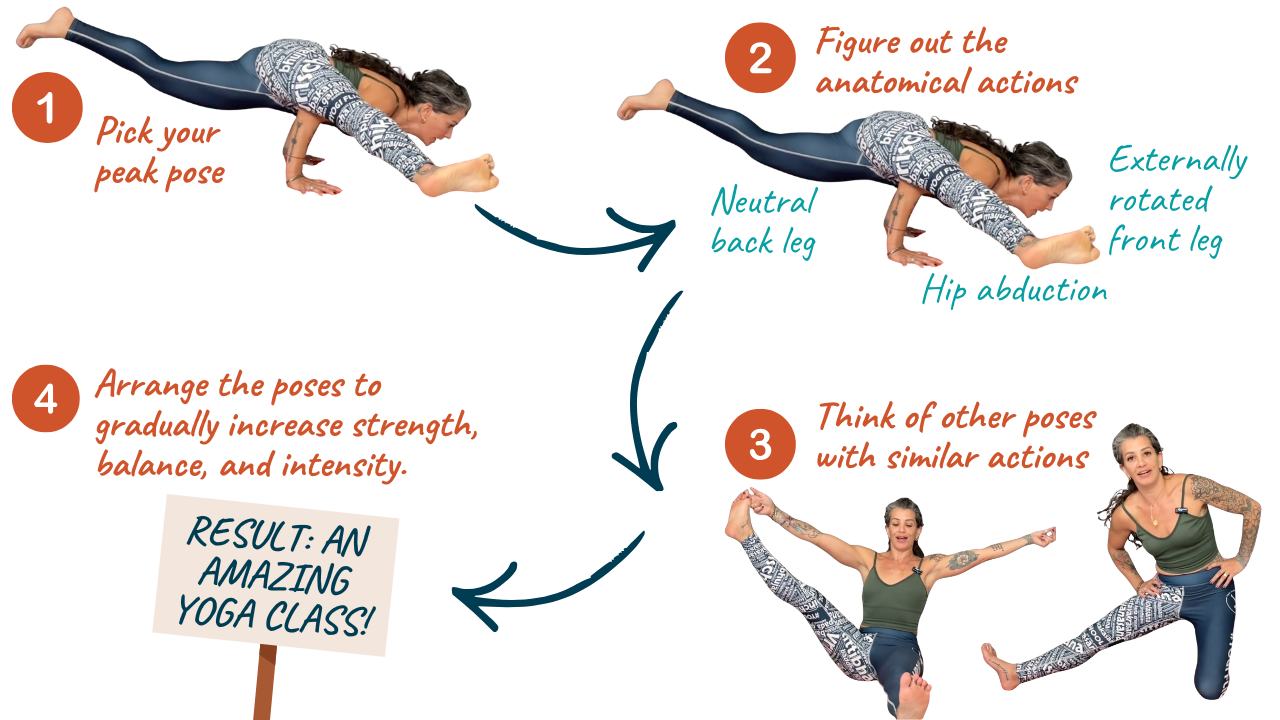 By thinking in terms of pose families rather than isolated shapes, you create classes that are cohesive, intuitive, and safe. And the best part? Your teaching becomes way less stressful, you have a clear roadmap, and your students actually get where you’re trying to take them.
Want to see all of this in action?
Check out my YouTube video where I break all of this (and more) down!
And if you want even more guidance, check out my brand new No Bullsh*t Peak Pose Sequencing Course and discover a step-by-step training for yoga teachers (and passionate practitioners) who want to build intentional, intelligent, peak-pose vinyasa classes with confidence.
