
Why Tadasana (Mountain Pose) Is Secretly in Every Yoga Pose You Do
Tadasana is one of those yoga poses that's easy to ignore. Nobody's lying awake at night thinking, "Man, I really need to nail my Tadasana."
You stand there, feet on the floor, arms by your sides or hands together at your chest. Seems simple enough.
But Tadasana is more important than it looks.
Think of it as point zero. It's a simple reference position where you can see what your feet, legs, pelvis, spine and shoulders are doing before you start going anywhere else.
Because that's really what you're doing in every other yoga pose.
You're taking the same body that's in Tadasana and changing its relationship to gravity, the floor, or different parts of itself. You lift a leg. An arm moves out to the side. Your spine twists.
So rather than learning every yoga pose as a completely separate thing, you can start with a simple question:
What changed from Tadasana?
That might sound ridiculously simple, but it's a very different way of learning yoga - and a simple way to learn and teach anatomical directions of movement.
Instead of memorizing a shitload of poses and trying to remember what you're supposed to do in each one, you're learning to see the connections between them.
Tadasana is Your Template
Before you can figure out what's changed, you need to know what you're changing from.
That's what makes Tadasana so useful.
You're standing on two feet, with nothing particularly dramatic happening. No balancing. No pretzel-making. No trying to keep your arms from falling off.
So you can really pay attention to what's happening in your body.
What's the relationship between your feet and the floor? Are you feet rolling in? Rolling out? Arches lifted or collapsing?
Are you able to slightly internally rotate your thighs and lengthen your tailbone down as you hug your legs in towards your midline?
What direction is your pelvis naturally pointing? And what happens if you lift your frontal hip points up a bit, or lower them down a bit? How does that change the sensations in your lower back?
What's happening with your ribs and shoulders? Do your ribs naturally stick out when you stand, or are they naturally drawn in?
Do you shoulders roll forward, or are your collabones wide?
What does it feel like when you "lengthen your spine" or "firm your quads"?
It's much easier to notice these things when your body isn't busy trying to do twelve other things at the same time.
Tadasana gives you a chance to figure shit out.
Now Change Something
Moving into another pose isn't a brand-new problem to solve. You look at what stayed the same, and what changed.
Take Tree Pose. From across the room it looks like its own thing...but most of your body never left Tadasana.
Your standing leg is still in Mountain Pose: foot grounded into the floor, quad firm, tailbone lengthening down, the same long spine and steady shoulders you set up a minute ago.
If you ignore the lifted leg, the rest of your body is in Tadasana.
Only ONE thing really changes: the tree leg.
You lift a leg, abduct it out to the side and place your foot against your inner thigh. Add a little external rotation to really feel your outer hip muscles doing the work.
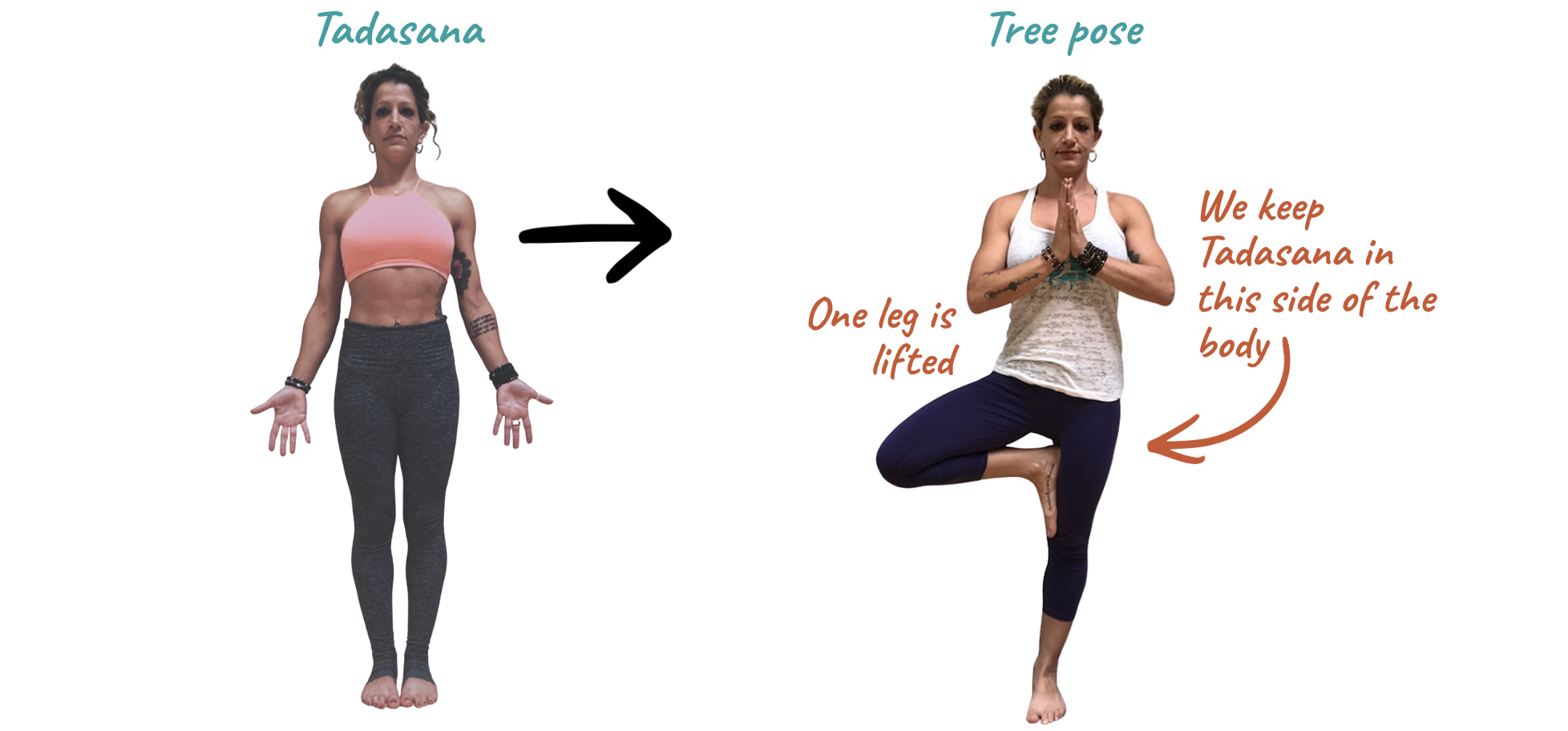
Looking for where Tadasana still exists in every pose helps you focus on what is changing, rather than looking at the WHOLE pose and getting overwhelmed.
And it beats learning Tree as a fresh list of rules called "Seven Things You Must Do In Tree Pose Or The Yoga Police Will Arrest You."
(Psst... Ever heard you shouldn't put your foot on your knee in Tree Pose? Here is why that's bullsh*t!)
This is what I mean when I say that every pose has Tadasana in it.
And this is where it gets useful
If you learn yoga pose by pose, you end up with a giant mental filing cabinet.
Tree goes in one drawer. Warrior III goes in another. Downward Dog gets its own drawer. Then every time you learn a new pose, apparently you're supposed to find somewhere else to put it and remember the seventeen instructions that came with it.
No wonder yoga can feel like there's so much to remember.
But if you start looking at poses as variations on Tadasana, you're not just collecting shapes anymore. You're learning what happens when you move the body.
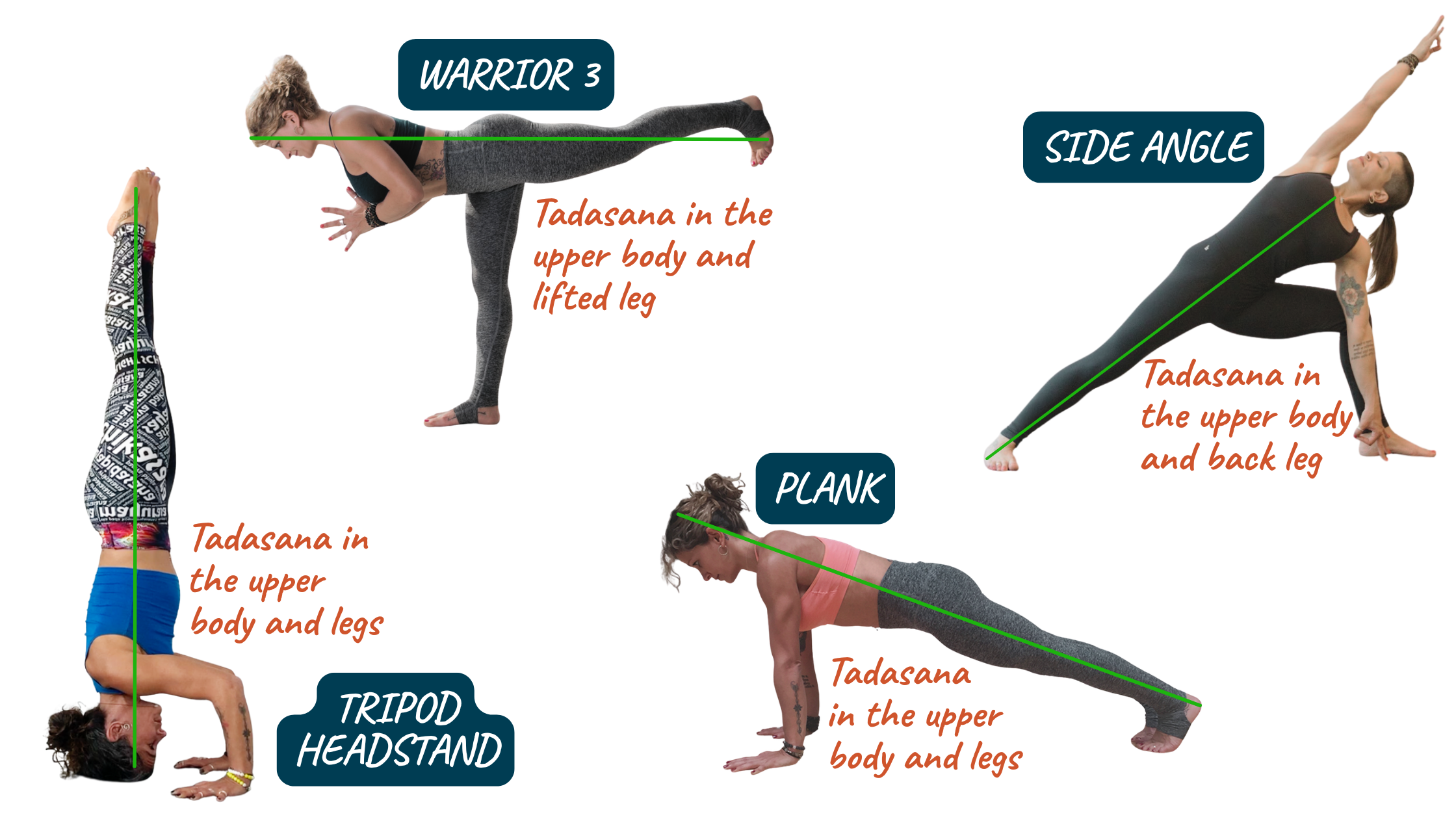
A leg lifts. The feet move apart. The hips rotate. The spine flexes or extends. The arms move overhead. The body tips forward, sideways, upside down.
Those are things you can understand. And once you understand the movement, the pose attached to it becomes a lot easier to make sense of.
If all you know is what the finished pose is supposed to look like, you're going to spend a lot of time trying to make people match the picture.
If you understand the movements underneath the pose, you have a lot more to work with.
You're not just asking, "What are the cues for Warrior 3 again?" You're asking what you're really trying to change from their starting position, what needs to move, and what doesn't.
That's the difference between just knowing the shapes of yoga poses and actually understanding what you're teaching and why.
Start Looking for Tadasana
So next time you practice, pick a pose and look for the Tadasana underneath it.
Look at what stayed familiar and what changed.
What happened to the feet? What happened to the legs? What happened to the pelvis? What happened to the spine? What moved, and what changed because of that movement?
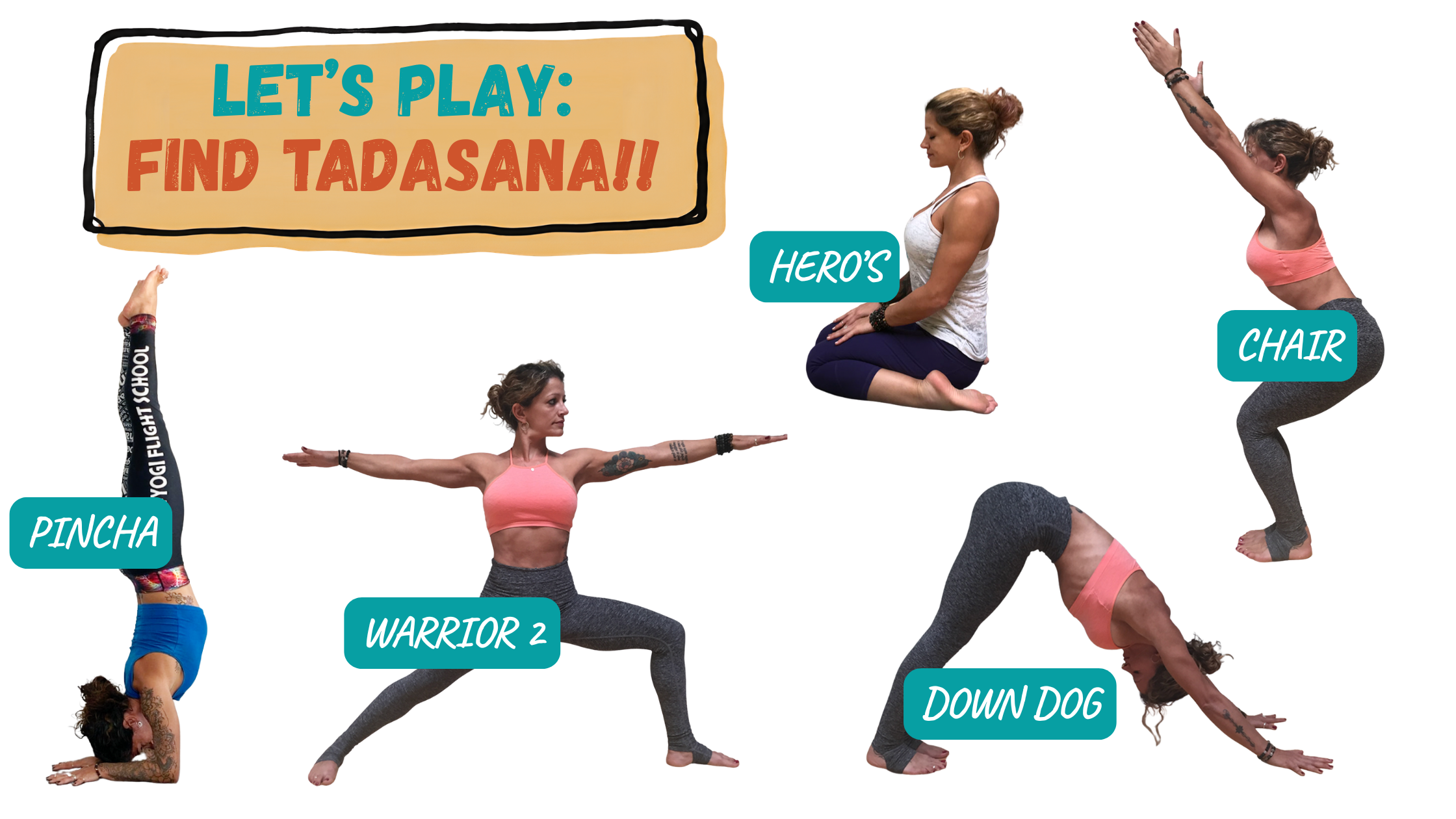
Start doing that with enough poses and you'll probably start noticing something: yoga isn't quite the giant pile of separate instructions it can sometimes feel like.
There are patterns. There are relationships. There are things your body does again and again, just in different combinations.
And Tadasana is a pretty damn good place to start seeing them.
Want to go deeper?
If this way of thinking about yoga is making your brain go, "Ohhhhhh...", you're going to like what I've got coming.
I'm putting together a brand-new course that takes the entire curriculum from my 200-hour yoga teacher training and breaks it down by topic, so you can finally learn what you need instead of trying to cram an entire yoga education into your head at once.
Anatomy, philosophy, sequencing, teaching skills, modifications, assists, all of it. Not just the sexy bits.
It's launching Tuesday, September 15th.
And if you want a little taste of how I teach this stuff, the video below is an actual lesson from the course, where I break down Tadasana and the directions of movement in more detail.
