
Not Everything That Happens on Your Yoga Mat Means Something About You

Ever noticed how good we humans are at taking one little thing and turning it into a whole dramatic story?
"I couldn't hold Crow for more than half a second...clearly I'm not strong enough for arm balances!"
"I wobbled all over the place in Tree...apparently I suck at yoga!"
"I fell out of Wheel three times...obviously I'm too stiff for backbends!"
And it's not just yoga. We do this everywhere in life.
"I made dinner and it tasted awful...I should never cook again."
"My friend hasn't replied to my message...I must have done something to annoy them."
"My boss asked if I had a minute...if you need me, I'll be over here planning my going away party."
It's an impressive trick, really.
We take one tiny piece of information and decide it means something much bigger
Something super simple happens, and within seconds we've morphed it into a full-blown TeleNovela, most often without stopping to check whether it's even remotely true.
Luckily for us, yoga philosophy has been paying attention to this particular human habit for quite a while, because we have something called Svādhyāya that can help us start to understand why we do this.

Svādhyāya is one of the niyamas, the inner philosophical practices of yoga, and it's usually translated as "self-study" or "self-inquiry". (If you want to read more about the niyamas, click here to read about Santosha, the niyama of contentment.)
Now, "self-study" can sound deep and a little intimidating... Do I need to sit cross-legged in a forest questioning whether I will attain Nirvana if I don't wear a loincloth? Must I investigate every toenail I trim to see if it contains an answer to the universe?
Short answer: no (but if you really want to, knock yourself out). Svādhyāya is basically the practice of getting curious about yourself.
It is the practice of asking yourself questions such as: What stories do I tell myself about something that happened? Why do I interpret things a certain way? Am I the person who gets defensive when someone questions me? Am I someone who immediately assumes the worst when I get a "we need to talk" text from my boss...?
This is Svādhyāya. Who am I being, and why?
Your yoga mat is a pretty great place to practice Svādhyāya
Let's say you're in class and you fall out of a headstand. That's it. That's all that happened. You fell out of a headstand. Cue the closing credits, it's the end of the TeleNovela.
But your brain throws on its best Spanish accent and says, "oh no, no, no, no señor! It wasn't just a fall! We fell because we suck at yoga! We fell because the teacher was a sub! Actually wait, I meant to fall! Yes, I was practicing my dismounts! Don't you judge me!!"
Suddenly, you've gone from "I fell out of a headstand" (a simple fact) to "I suck at this. I should never do headstands again" (a completely made-up interpretation of events... Spanish accent optional).
Svādhyāya asks you to get curious about that part. Not, "How do I stop falling out of a headstand?" More like: "Huh. I fell out of a headstand and immediately decided that meant something about me. Why did I do that?"
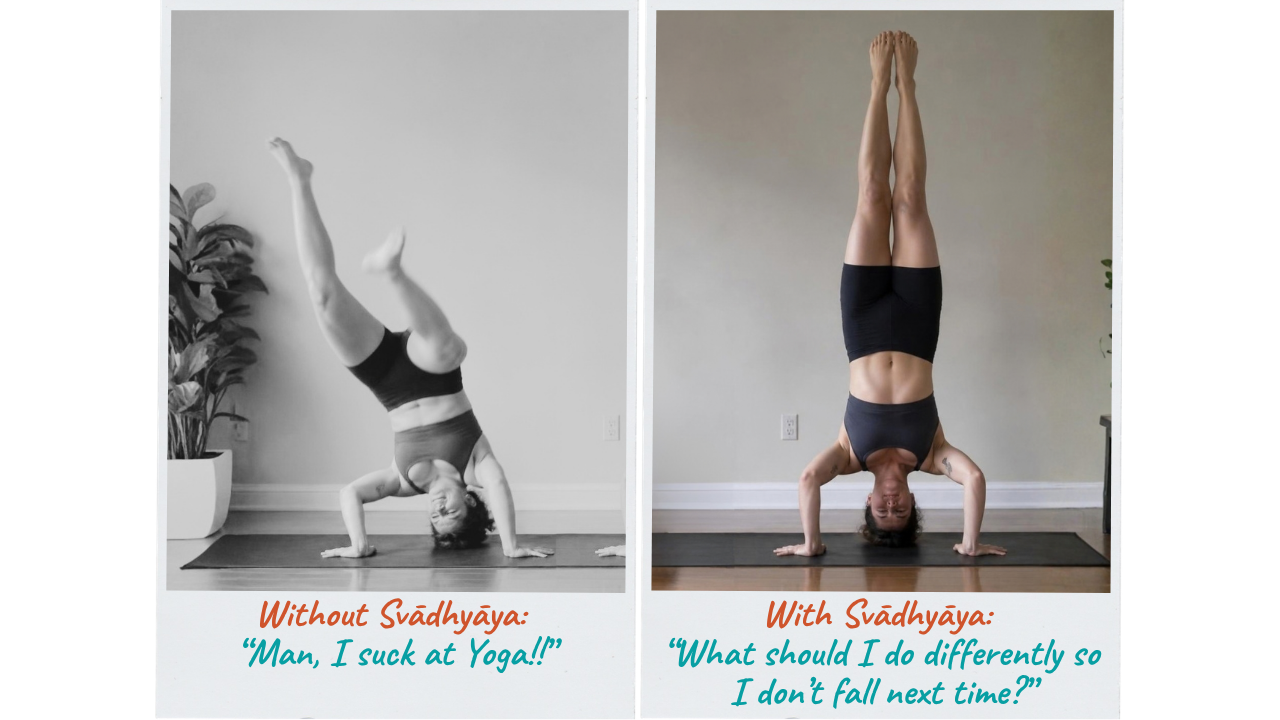
The event is one thing. The meaning you attach to it is another
Once you start practicing Svādhyāya on your yoga mat, you may start noticing the same thing happening in other parts of your life. A co-worker questions your work and you decide they don't respect you. Someone compliments you and suddenly you need them to keep telling you how good you are. A teenager glances at your new jeans and you assume you're going to end up on their TikTok tagged as #OkBoomerFit.
Now you have something to study.
Not just what happened, but the story you immediately created about what it meant, and what that story says about the person you think you are.
Maybe you're right. Maybe your co-worker really doesn't respect your work. Maybe your friend really is annoyed with you. Maybe the teenager really is judging your jeans. The point isn't to automatically replace the story with a nicer one.
The point is to pause long enough to ask:
→ Is that what happened?
→ Do I know that for sure?
→ What else could be true?
→ Why did I immediately make it about me?
Because when you start separating what happened from what you decided it meant, you have a little more information to work with.
You might realize you don't have enough information yet, realize you've fallen into a pattern you recognize from somewhere else, or you might even realize your first interpretation was right.
Either way, you've stopped treating the first story your brain produced as the whole truth, and maybe you caught the TeleNovela before it got nominated for 5 Emmys.
That's Svādhyāya. Not trying to become some perfectly self-aware human who never gets defensive, never makes assumptions and definitely never mentally fights a yoga teacher in the parking lot...
It's becoming someone who is getting a little more curious about the person they are being when things happen.
Prefer the TL;DR version? Check out the video here:
Ready to have the facts instead of a TeleNovela in your arm balance or inversions practice?
That's a big part of what we do inside Yogi Flight School: we show you what's really going on in the pose, so when you fall, you've got a fact to work with instead of a dramatic story about what it says about you.
