
Tripod vs Bound Headstand: Why "Easier" Depends Entirely on Your Body
I can teach both tripod and bound headstands in the same class and watch the room split clean down the middle.
Half my students float into bound headstand like they've been doing it their whole lives. The other half wrestle with it for a few minutes, switch to tripod, and immediately go, "Ohhh... that's so much better."
Then both groups look at each other like the other one is completely nuts.
This is exactly why it drives me a little bit bonkers when bound headstand gets labelled "the beginner version" and tripod gets treated like the advanced one.
Says who!?
Because after teaching these poses for years, I can tell you that neither one is objectively easier. They simply ask different things of your body.
The biggest thing that determines which one you'll get along with most? Your shoulders.
Today we're looking at what each pose actually asks of your shoulders, and why that one factor can completely change which headstand feels easiest.
Bound Headstand (Salamba Sirsasana)
In bound headstand, your forearms are on the floor and your hands cradle the back of your head. This version sneakily asks quite a lot from your shoulders. You need a good amount of overhead shoulder flexion (meaning, your ability to raise your arms overhead).
Once you're in the pose, you don't just rest on your forearms. You actively press them into the floor, lifting through your shoulders instead of collapsing down toward your ears. When that action is available, your forearms take a significant share of your body weight, which is why a well-aligned bound headstand often feels surprisingly light on the head.
The other piece of the puzzle is your base. Because your elbows stay relatively close together, you're balancing on a much narrower foundation than you are in tripod. A narrower base is naturally a little less forgiving, and because your hands are wrapped around your head instead of pressing into the floor, you don't have much in the way of what I call a "braking system."
If your balance starts to drift, there isn't much you can do to steer yourself back.
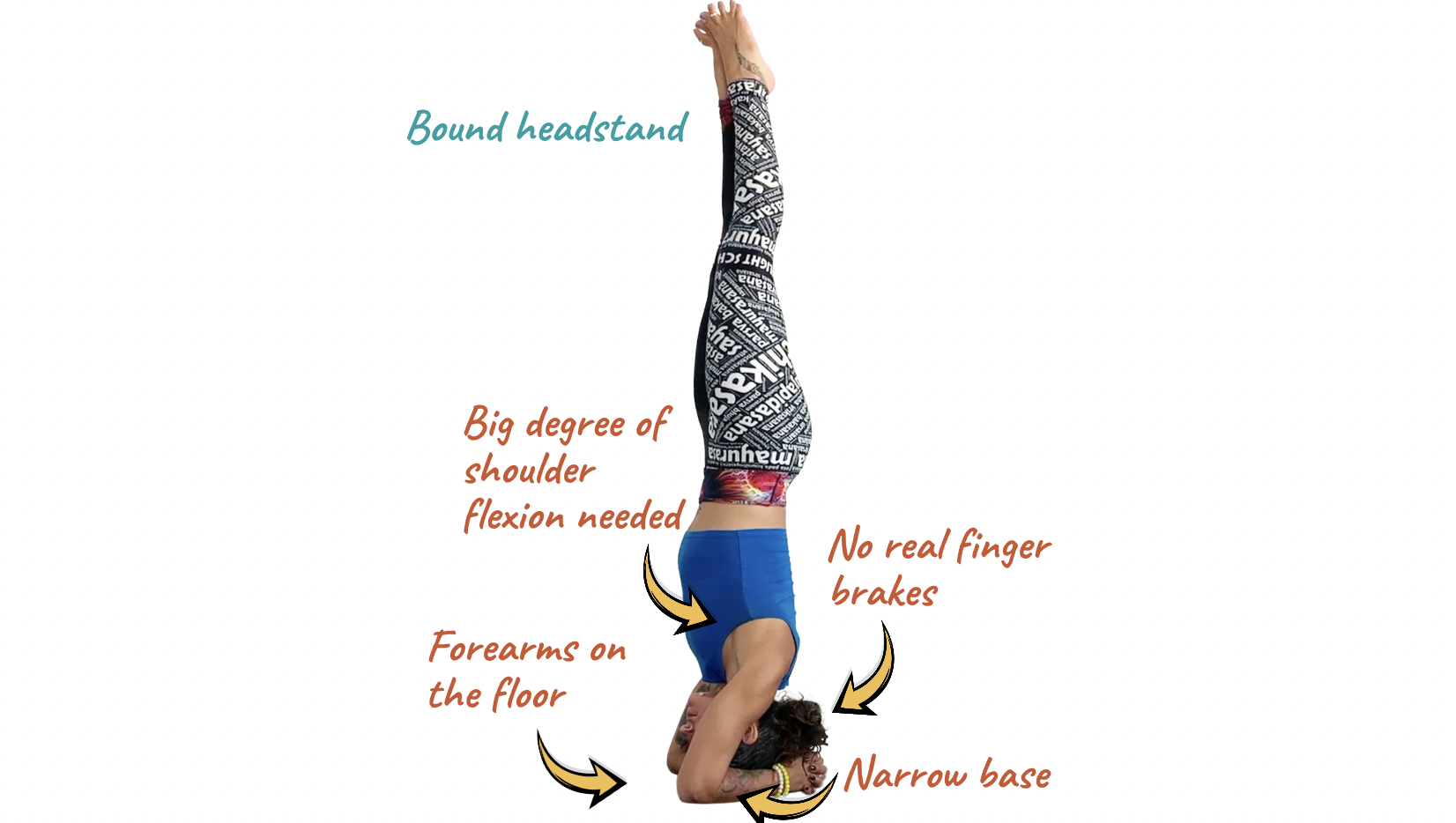
If your shoulders don't yet have the overhead range this position asks for, that's when bound starts to feel unpleasant.
→ It becomes much harder to keep pressing firmly through the forearms
→ Your shoulders begin to collapse
→ More weight drops into your head and neck
...and the pose suddenly feels unstable.
That's usually the point people decide they "can't do headstand," when really they're just asking their shoulders to work in a range that they don't have yet.
Tripod (Mukta Hasta Sirsasana)
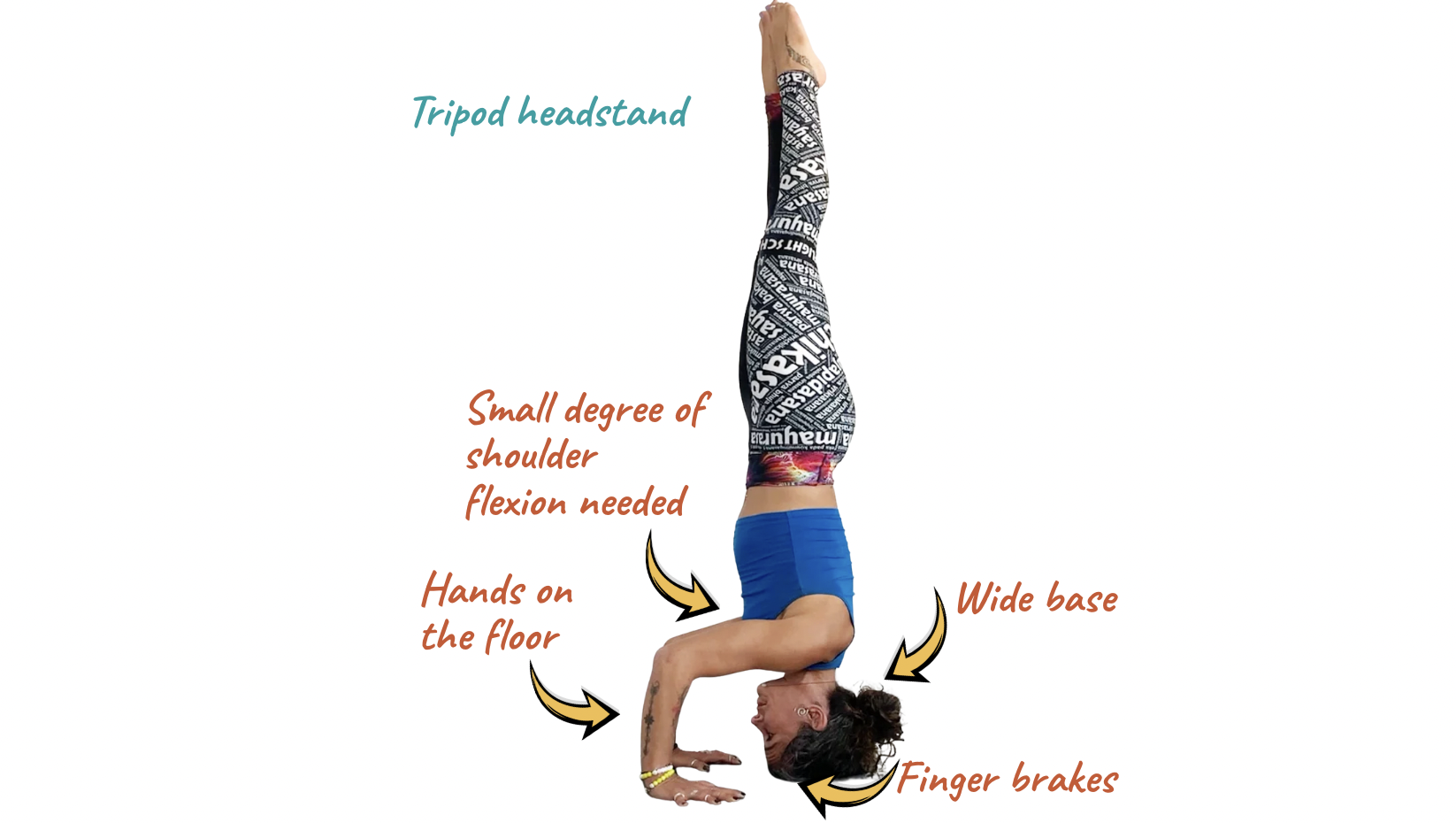
Instead of balancing on your forearms, your hands are flat on the floor about shoulder-width apart, creating a much broader base to work with. Your shoulders still move overhead, but nowhere near as far as they do in bound headstand.
Instead, they're working in a position that's much closer to Crow Pose or Chaturanga, where you're actively pushing the floor away through your hands.
For anyone who's already spent time in arm balances, that position usually feels far more familiar than the deep overhead reach bound headstand demands.
The wider base also gives you a little more room for error, but the biggest advantage is that your hands can actually help you balance.
→ If you start tipping forward, you can press into your fingertips (this is the "braking system" I referred to earlier).
→ Drift backwards, and you can push into the heel of your hand.
Those tiny adjustments let you constantly fine-tune your balance in a way that's simply not available in bound headstand.
The trade-off is that tripod asks more from your pressing strength. Your shoulders, chest and triceps are working the entire time to support you.
If you've already spent time in Crow Pose, Chaturanga or other arm balances, that strength is probably already there, which is why so many people step into tripod and immediately think, "Well... this is way easier."
So Which One Should You Learn First?
The answer depends entirely on the body you're bringing to the mat.
If tripod feels better right now, lean into it. You'll build confidence upside down, learn how to balance, and strengthen the exact muscles that make inversions feel stable. At the same time, you can gradually improve the shoulder mobility that bound headstand asks for.
If bound feels easier, brilliant. Enjoy it, and let tripod become the thing that builds your pressing strength and teaches you how to balance through your hands.
One of the biggest mistakes I see is people trying to force the version they think they should be able to do instead of working with the one their body is actually ready for.
Yoga has a funny habit of labelling one variation "beginner" and another "advanced," but bodies don't always follow those rules.
So instead of asking which headstand is the "right" one, ask yourself which one gives you the best chance of learning well, and build confidence there first. The other variation isn't going anywhere, and you'll usually get there much faster by working with your body instead of arguing with it.
If you want more game-changing inversion breakdowns like this one, my signature program, Yogi Flight School, is exactly what you need! Check out all the details of Yogi Flight School here.
Want to see Tripod in action?
Check out my YouTube video where I break tripod headstand down step by step!
