
The Vinyasa Breakdown I Wish I'd Had When I Started Practicing Yoga
Vinyasas are one of those things that show up in almost every flow yoga class (heck it's even in the class name!)…yet quite often no one ever really explains them.
For the longest time, I stumbled my way through plank - chaturanga - up dog - down dog whenever my teacher called out "take your vinyasa" without actually understanding how I was supposed to breathe, what the rhythm was, or why my transitions felt clunky while everyone else looked like they were floating on air.
Once I finally learned what a vinyasa is (not just the individual poses, but the breath pattern and the purpose behind it), everything clicked. My practice felt smoother. My breath actually led the movement (instead of the other way around). And I stopped muscling my way through something that was supposed to feel fluid.
So that’s what we’re diving into today: what a vinyasa really is, how to move through it with the cadence of your breath, and the modifications that make it accessible (whether you’re building Chaturanga strength, nursing an injury, or simply trying to find your flow without feeling like a soggy noodle on the way down).
Let’s break it down, clearly, simply, and without the mystery.
What is a vinyasa, really?
A vinyasa isn’t just a string of poses. The word “vinyasa” has a few different meanings depending on the context:
-
A series of postures: this is probably the most common definition. When your teacher cues you to "take your vinyasa", they are cueing you to flow from downward-facing dog to plank to Chaturanga to upward-facing dog and back to downward-facing dog.
-
The name of a class style: many yoga classes are labeled “Vinyasa Flow” or simply "Vinyasa" because they focus on linking poses together as fluid movements, in contrast to more static styles of yoga such as Hatha.
-
Linking breath and movement: for many, the heart of vinyasa is how your breath carries your body from one pose to the next. We use the breath to lead the body, rather than the other way around. (Want to read more about linking breath with movement? Check out this blog post!)
-
To place in a special way: this is the Sanskrit root of the word and reminds us that every movement and pose has an intention behind it - yoga is not just motion for motion’s sake.
How to move through a vinyasa with your breath.
Today we’re focusing on the physical definition of vinyasa - the actual sequence of poses you often hear called out in yoga class. A typical vinyasa from downward-facing dog looks like this:
- Inhale as you shift forward into plank from downward-facing dog.
- Exhale as you lower down into Chaturanga.
- Inhale as you lift into your backbend (either upward-facing dog or cobra).
- Exhale as you send your hips back up and back into downward-facing dog.
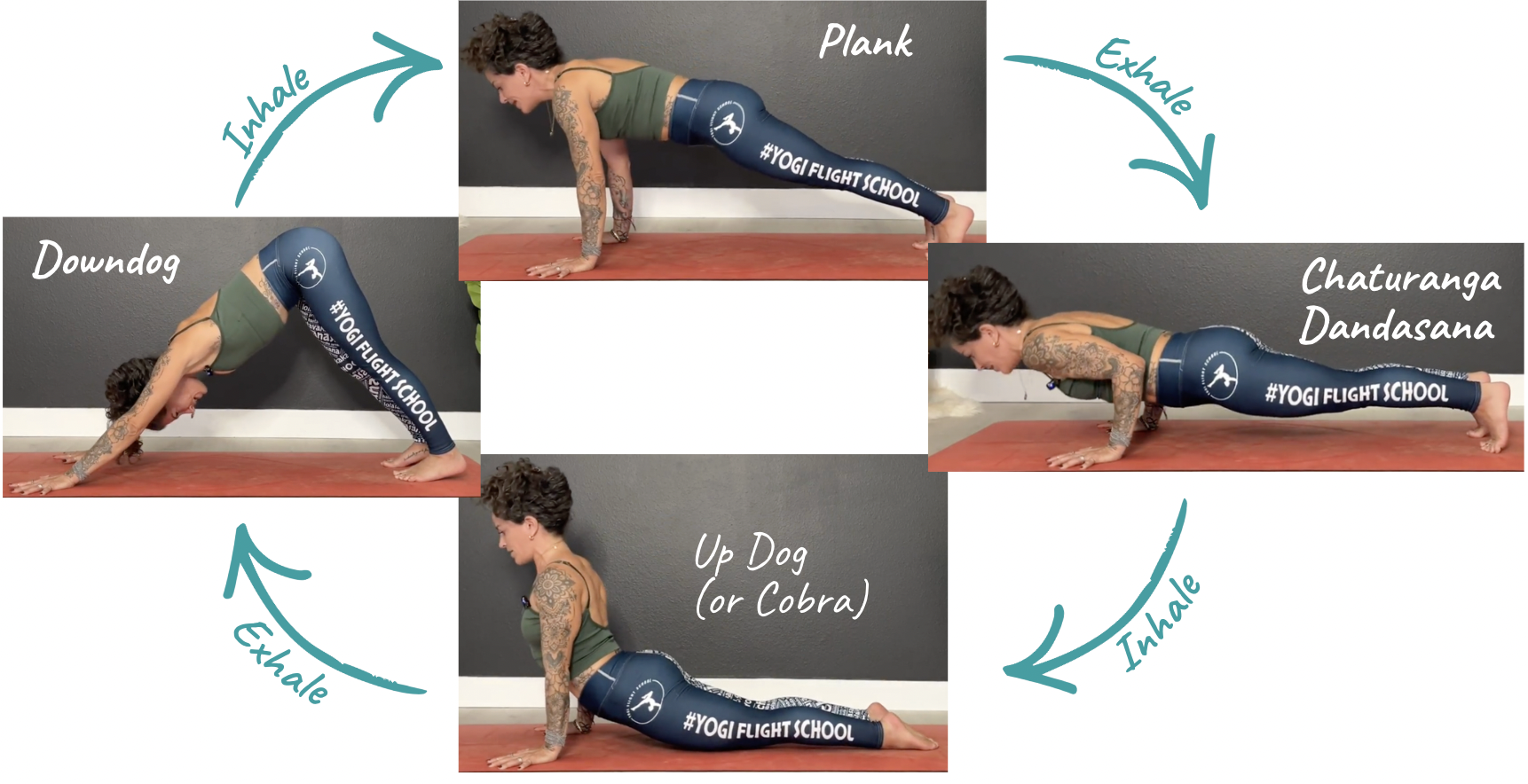
The trick is to let your breath lead the movement, not the other way around. Keep your Ujjayi breath steady and even...don’t rush it, don’t drag it. When each movement matches your inhale or exhale, the whole sequence feels smooth and connected instead of jerky and awkward.
How to modify your vinyasa.
Injuries, flexibility, or simply feeling tired can all make a vinyasa challenging. In these cases, modifications are your BFF. They let you stay in the flow without increasing the risk of injury, sacrificing form, or losing the rhythm of your breath.
Here are a few ways to modify the flow depending on your needs:
1. Chaturanga-free option: If you're not quite ready for a full Chaturanga, lower down to your belly instead. Then inhale into cobra or upward-facing dog, and exhale your hips back into downward-facing dog. 
2. Floor-free option: For those who want to avoid going to the floor for whatever reason, you can replace Chaturanga and the backbend with cow pose in tabletop. Inhale forward into plank, exhale lower the knees, inhale into cow pose, and exhale moving your hips back into downward-facing dog. 
3. Wrist-free option: Wrist pain is common but doesn’t mean you have to sit out. Swap downward-facing dog for dolphin pose, plank for forearm plank, and upward-facing dog for sphinx pose. Your breath still leads your movement, and your wrists get a break while you stay connected to the flow. Modifying doesn’t mean you’re missing out. It’s about meeting your body where it’s at, maintaining fluidity, and keeping your practice safe and sustainable.
Putting it all together!
Think of each vinyasa as a small moving meditation. Even a modified version carries the rhythm, strength, and intention that make this sequence so powerful. With practice, the transitions will feel smoother, your body will respond with more ease, and your breath will naturally lead the flow.
The beauty of vinyasa is that it meets you where you are while still giving you room to grow. Keep experimenting, stay mindful of your breath, and let your body find its own version of the flow.
Want to see all of this in action?
Check out my YouTube video where I break all of this (and more) down!
And if you want even more guidance, my No Bullsh*t Yoga Pose Library has 90+ yoga poses (including every pose you'll see in a vinyasa!) fully broken down, with modifications, alignment tips, and confidence-building cues.
