
What Yoga Philosophy Has to Do With Your Handstand
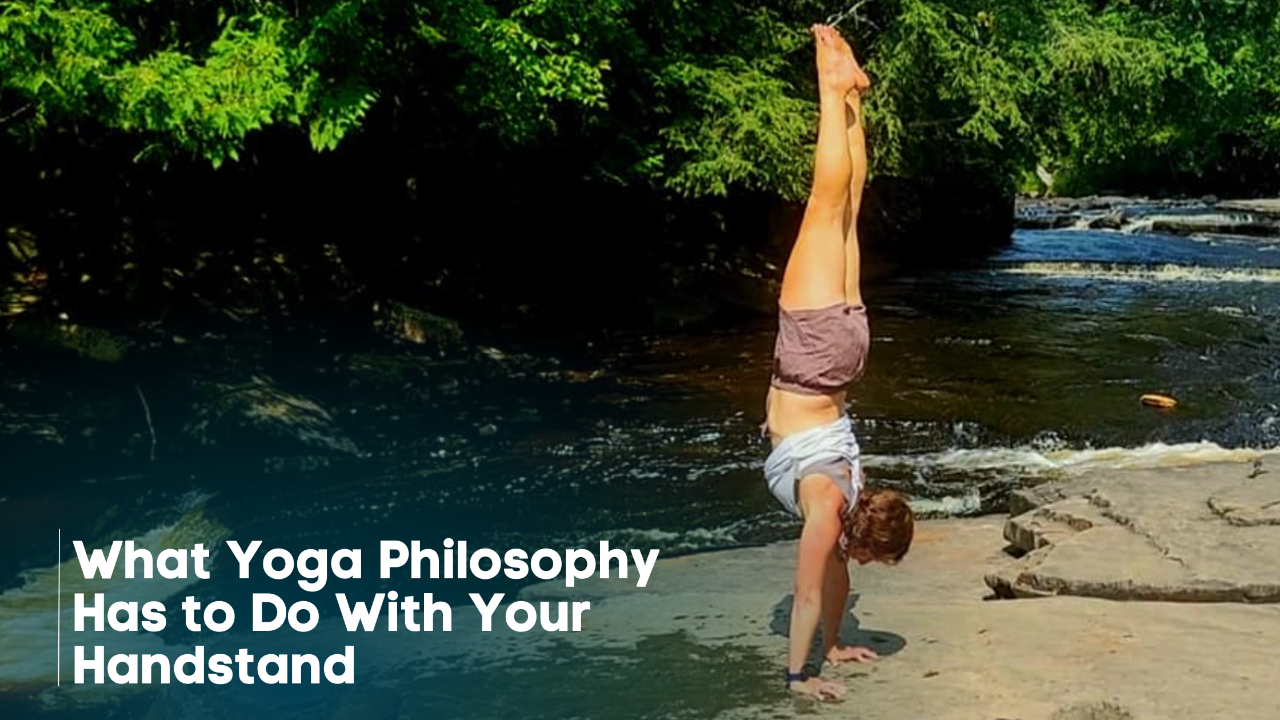
Imagine I could hand you a perfect freestanding handstand right now.
No falling, no faceplants, no kicking your feet into the air a gazillion times wondering if you're actually improving or just repeatedly demonstrating the theory of gravity.
You just have a perfect straight-line handstand. Effective immediately. Would you take it?
Of course you would.
But sit with the idea for a hot minute, because if it really happened, I think you'd feel oddly meh about the whole thing.
If all you really wanted was the shape of a handstand, you could just photoshop yourself upside down, post it on Insta (remember the inspirational hashtags!) and call it a day.
So I'm fairly sure a handstand you didn't earn isn't what you were after. Not really.
What you're actually after is to become the person who can do the handstand.
Let me explain...
The handstand isn't really the point
To hold a freestanding handstand, you have to become a particular kind of person first.
Someone patient enough to work on the same thing for months without asking, “Okay, but when does the part where I'm instantly brilliant at it start?”
Someone consistent enough to show up on the days they can't be bothered to even get out of their pajamas.
Someone curious about how their own body works instead of getting furious because what do you mean I have to warm up my shoulders again, I just did that yesterday!
And most importantly, you need to become someone who can suck at something for a while without deciding it means anything about you.
Which is convenient, because learning to handstand involves a frankly unreasonable amount of sucking.
Most of us try to skip the sucking. We want the result without having to spend all that annoying time in the middle.
We want to be good at handstands right now.
But the sucky part is where all of the learning happens.
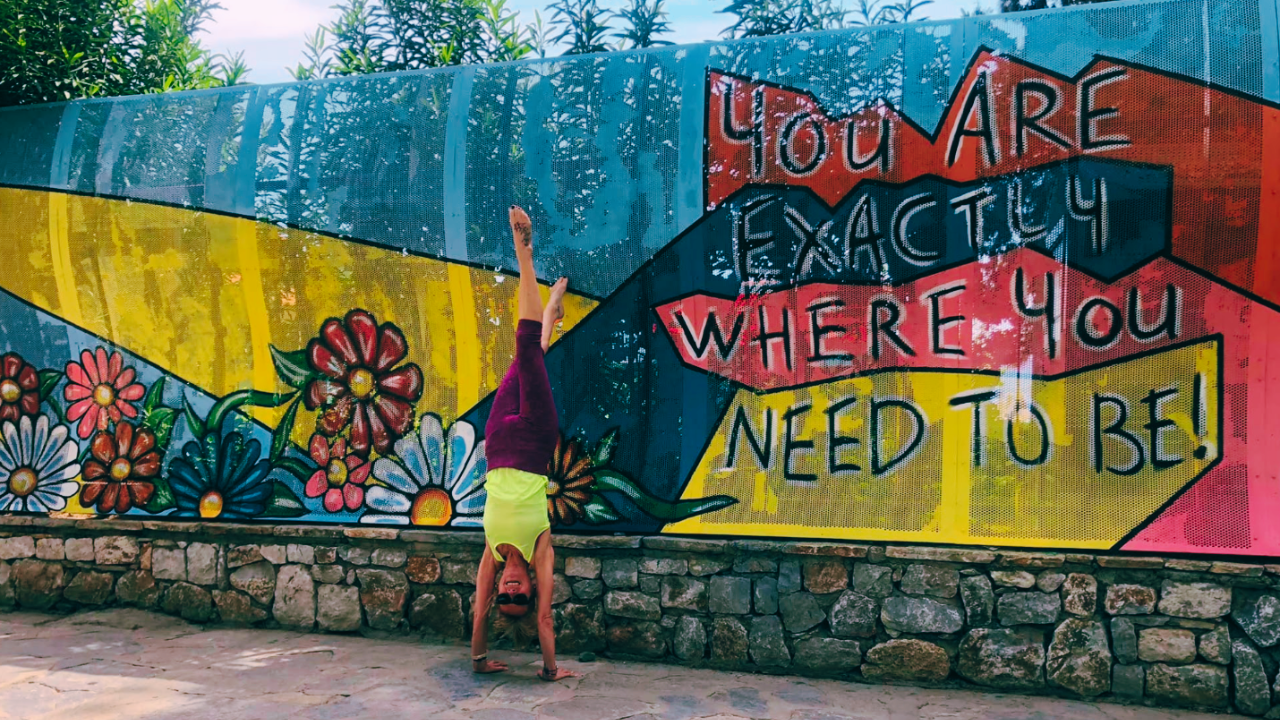
This is where Yoga Philosophy comes in
There's a word in Yoga philosophy for what most of us are missing on the handstand journey: santosha.
It means contentment.
It usually gets translated as "be happy with what you've got," which makes it sound like a cheesy fridge magnet you'd buy in a crystal shop in Sedona.
But santosha is much more useful than that.
Santosha isn't settling for less. It doesn't mean deciding you don't really want the handstand after all and pretending you're thrilled to spend the next six months in child's pose instead.
Santosha is finding contentment in the process.
It's being okay with where you are while still wanting to move forward.
You can want the handstand. You can work your ass off for it. You can be completely determined to get it.
But you don't have to make having the handstand the thing that decides whether you're happy with today's practice.
Because some days your practice is going to be brilliant.
And some days you're going to spend 20 minutes kicking up and the closest you'll come to balancing is 0.7 seconds in a shape that can only be described as a beached turtle.
Santosha is being able to have both of those practices and still be okay with where you are.
That's pretty f*cking hard to do.
Because it's easy to be content with the process when the process is going well.
It's much harder when your feet refuse to cooperate, your shoulders are tired, and you're starting to wonder whether handstands were really worth all this trouble in the first place.
But that's where the actual practice is.
Not in pretending you don't want the result. In learning how to be okay before you have it.
And that's surprisingly easy to forget when you really, really want the thing.
So flip it
Decide that today's job isn't to nail the handstand.
Today's job is to practice being the person who can learn a handstand.
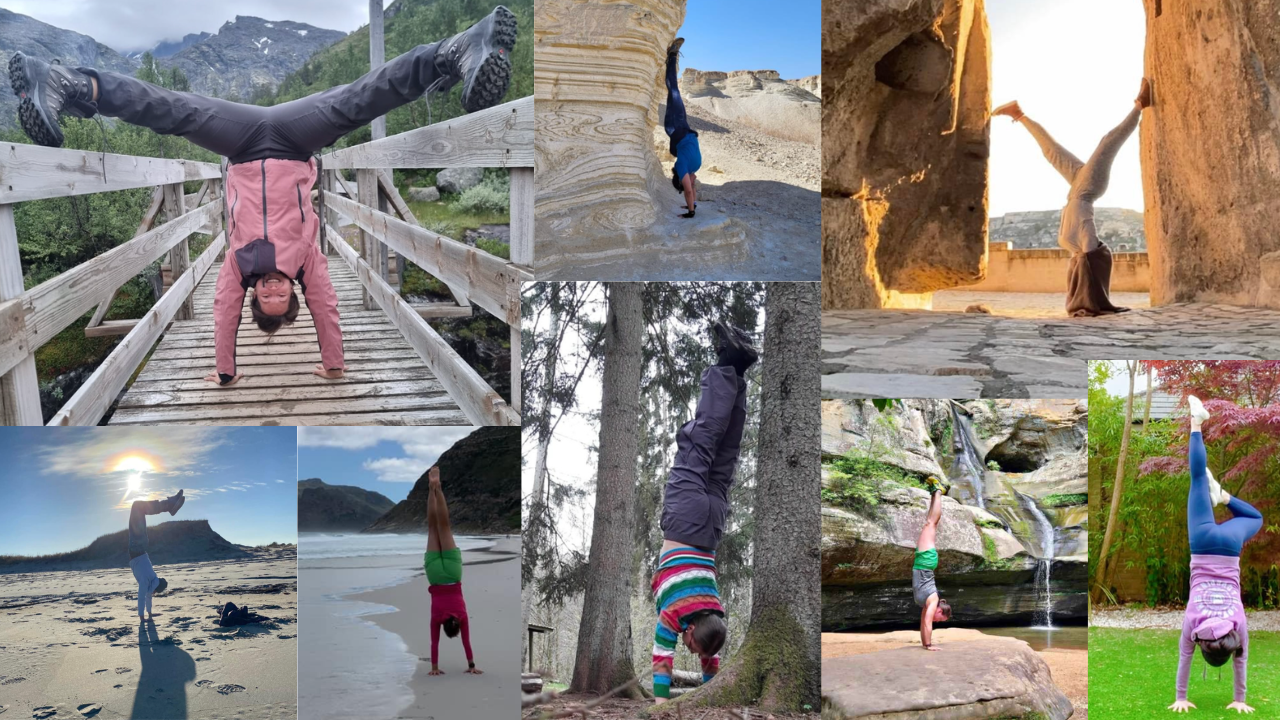
Be curious. Try things. Fall over. Get back up. Keep showing up.
And when today's practice is absolute garbage, try not to make it mean that you are absolute garbage too.
That's santosha.
Not giving up on the thing you want. Not pretending you don't care.
It's being okay with where you are while still working towards where you want to be.
And honestly, that's useful far beyond handstands.
Because life has a frankly unreasonable amount of sucking in it too.
Turns out the most practical handstand tip I've got is a two-thousand-year-old one.
Ready to become that person?
If you want to learn how to handstand without losing your mind in the process, come join us inside Yogi Flight School.
We'll teach you the drills, mechanics, and skills you need to get upside down, without turning every practice into a referendum on whether you're good at yoga.
Want to go deeper on santosha?
There's a lot more to santosha than "be happy with what you've got."
If you want to nerd out a little more, I wrote a whole article about it here.
And in the video below, I break down what santosha actually means and what it looks like to practice contentment both on and off your mat.
